Worked example · 01
Menopause in the OMOP vocabularies
If you already know menopause clinically, you can use it to learn your way around the OMOP vocabularies. Search it in ATHENA, find the same concepts in ATLAS, build a concept set and a cohort from them, then turn what you have found into a research question.
← Back to Learn Example 02: preterm labor → Open in ATHENA ↗ Open in ATLAS demo ↗
Current as of 1 August 2026. The counts and concept IDs below come from an ATHENA export taken that day, under vocabulary release v20260227. Vocabularies are updated a few times a year, so treat the numbers as something to reproduce rather than to cite.
What a vocabulary search returns
Type menopause into ATHENA
and you get a long list. Notice first that the list holds many things that are not related to the study
you are trying to design.
You build with the 75 standard concepts. The rest are source codes from national coding systems, product labels, and terms that have been replaced over time. That ratio is normal for any clinical word, and reading the list mostly comes down to recognizing which kind of thing each row is.
What else the search picks up (7 kinds)
| Kind of hit | Example | What it is |
|---|---|---|
| Over-the-counter products | 163 product-label concepts, mostly homeopathic remedies named for menopause | The word appears on a package, not in a patient record |
| A drug for a different indication | Human menopausal gonadotrophin (Menopur), 2909978 | Menotropins are named for the source they were first purified from and are given in fertility treatment |
| Family history | FH: Early menopause 4050823 | Somebody else's menopause, recorded in a family history |
| Negation | Menopause absent 4128330 | A record that a woman is not menopausal |
| Care process | Menopause education 4193571, Menopause monitoring 4152040 | A conversation or a review happened, which can be before menopause |
| Qualifier values | Before menopause 4206716, After menopause 4144036 | These describe a measurement result rather than forming a record of their own |
| A device | Menopause thermal therapy wristband 37165887 | Equipment, not a diagnosis |
Menopause is stored in more than one place
Every concept has a domain, and the domain decides which table its records go into. For menopause the useful split is that menopausal status is Observation while conditions attributed to menopause are Condition. That distinction determines the concept set you build next.
Concepts, their domain, and the table that stores them (13 rows)
| Concept | ID | Domain | OMOP table |
|---|---|---|---|
| Menopause | 4059477 | Observation | OBSERVATION |
| Menopause finding | 4172857 | Observation | OBSERVATION |
| Menopause present | 4128329 | Observation | OBSERVATION |
| Premature menopause | 198715 | Observation | OBSERVATION |
| Age at menopause | 36676381 | Observation | OBSERVATION |
| Menopausal flushing | 4113666 | Observation | OBSERVATION |
| FH: Early menopause | 4050823 | Observation | OBSERVATION |
| Normal menopause | 4034019 | Condition | CONDITION_OCCURRENCE |
| Menopausal syndrome | 439082 | Condition | CONDITION_OCCURRENCE |
| Menopausal osteoporosis | 4136988 | Condition | CONDITION_OCCURRENCE |
| Genitourinary syndrome of menopause | 37209648 | Condition | CONDITION_OCCURRENCE |
| Postmenopausal bleeding | 195321 | Condition | CONDITION_OCCURRENCE |
| Menopause absent | 4128330 | Condition | CONDITION_OCCURRENCE |
Two to look at closely. Menopausal flushing (4113666) is Observation even though its sibling symptoms for headache, sleeplessness and depression are Condition, so a Condition-only set for "menopausal symptoms" leaves out the most common one. Normal menopause (4034019) reads like a status concept but is Condition domain, so it does not belong in an Observation-domain set however sensible its name looks there.
The same search in ATLAS
ATLAS reads the same vocabularies, so the same search gives you the same concepts. Both tools give you filters for narrowing the list by domain, vocabulary and standard concept. What ATLAS adds is record counts, which tell you how much each concept is used.
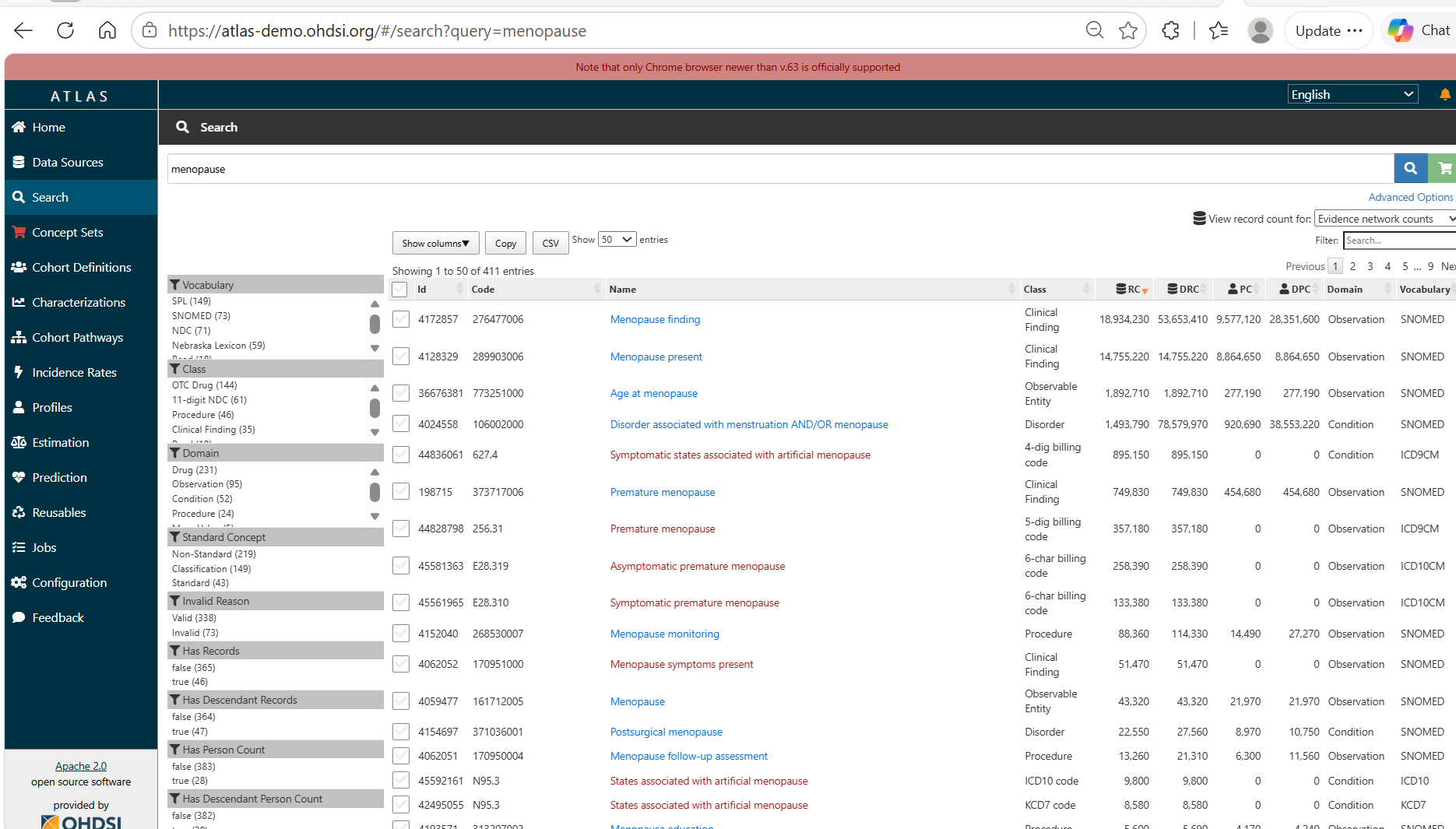
Record counts on this screen come from a network-wide reference set rather than from the data you are going to query. Use Data Sources to see what a specific data source holds.
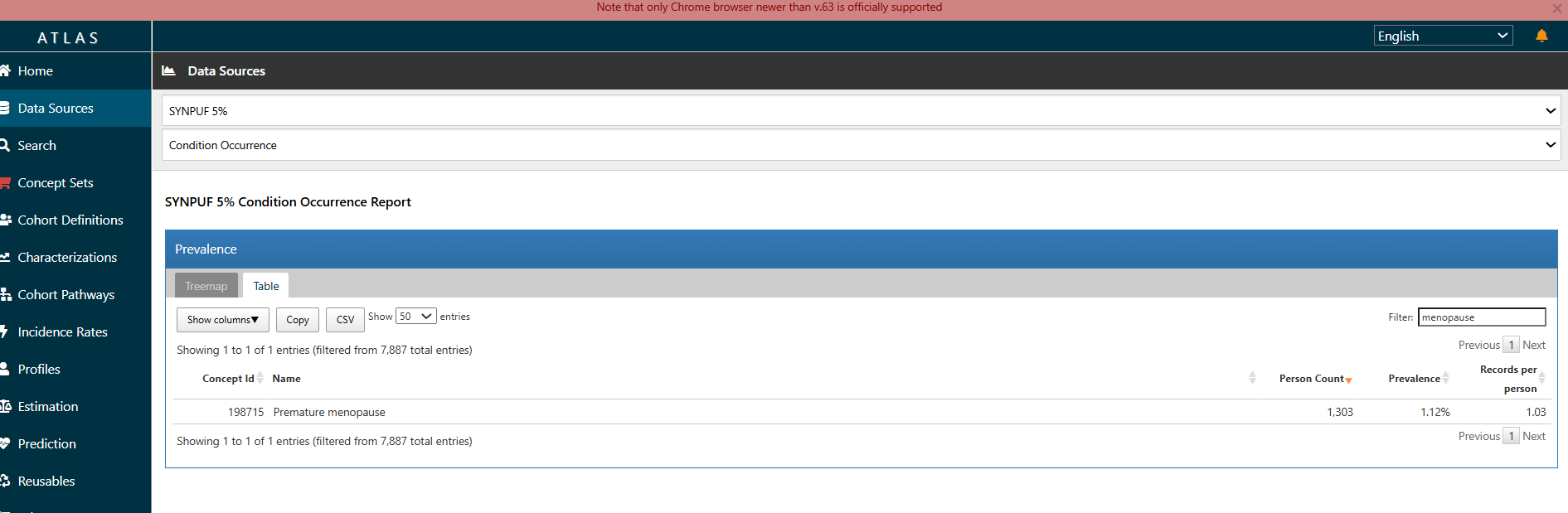
On the numbers here. SYNPUF is synthetic data built from Medicare claims, so its population skews old and includes men. The 1.12% shown is against everybody in that file rather than against women of the relevant age, which is why a prevalence figure always needs its denominator checked before it is used or reported as fact.
Building a concept set
A concept set is the code list your study runs on. Build it from standard concepts, turn descendants on so the specific terms clinicians write are included, and write down what you excluded and why. Keep each set to one domain, because the domain decides which table you query it against.
Menopausal status
The record that a woman has reached menopause, however it was written. Every concept here is Observation
domain, so this set is queried against OBSERVATION.
The concepts to include and exclude (5 rows)
| Concept | ID | Domain | Descendants |
|---|---|---|---|
| Menopause finding | 4172857 | Observation | Yes |
| Menopause present | 4128329 | Observation | Yes |
| Menopause | 4059477 | Observation | Yes |
| Exclude: FH: Early menopause | 4050823 | Observation | Yes |
| Exclude: FH: Late menopause | 4051695 | Observation | Yes |
The two family history concepts are standard, valid and Observation domain, which puts them in the same table as the rest of this set, so exclude them by name. Normal menopause (4034019) and Menopause absent (4128330) look like they belong here and do not, because both are Condition domain.
Conditions attributed to menopause
Clinical problems recorded as menopausal, which answers a different question from who has reached
menopause. Every concept here is Condition domain, so this set is queried against
CONDITION_OCCURRENCE.
The concepts to include and exclude (13 rows)
| Concept | ID | Domain | Note |
|---|---|---|---|
| Menopausal syndrome | 439082 | Condition | The broad one |
| Genitourinary syndrome of menopause | 37209648 | Condition | |
| Menopausal osteoporosis | 4136988 | Condition | |
| Postmenopausal osteopenia | 42536667 | Condition | |
| Menopausal depression | 4223090 | Condition | |
| Menopausal sleeplessness | 4113205 | Condition | |
| Menopausal headache | 4113841 | Condition | |
| Menopausal hyperhidrosis | 37165466 | Condition | |
| Postmenopausal bleeding | 195321 | Condition | Often recorded on its own, without a status concept |
| Postmenopausal urethral atrophy | 4054881 | Condition | |
| Climacteric arthritis | 79109 | Condition | |
| Exclude: Menopause absent | 4128330 | Condition | Records that a woman is not menopausal |
| Consider excluding: Disorder associated with menstruation AND/OR menopause | 4024558 | Condition | Its descendants reach well outside menopause |
Menopausal flushing (4113666) belongs in this list clinically but cannot go in it, because it is Observation domain. If your protocol says "menopausal symptoms," you need both concept sets, and that limitation belongs in the protocol rather than in a footnote discovered at review.
From concept set to cohort
A concept set says which codes count. A cohort says which people count, and from when. Two to build from the sets above.
First recorded menopausal status
Every part of the definition (7 rows)
| Part | Setting | Why |
|---|---|---|
| Entry event | Observation of any concept in the menopausal status set | The criterion is Observation, not Condition occurrence, because every concept in that set is Observation domain. Reaching for Condition out of habit returns nothing, and that looks like missing data |
| Initial event limit | Earliest event per person | Index is first recorded status, not most recent mention |
| Inclusion 1 | Female at index | The concept does not imply sex, so the rule states it |
| Inclusion 2 | At least 365 days continuous prior observation | Otherwise "first recorded" only means "first we were watching" |
| Inclusion 3 | Age 35 or over at index | A floor rather than a definition, and a clinical judgment to name as one |
| Exit | End of continuous observation | Menopause does not resolve, so a fixed window would be a statement about follow-up |
| Censoring | None | Nothing here makes later follow-up uninformative |
Then check it. The age distribution should sit in the late 40s to mid 50s, the index events should not be dominated by one source code, and incidence over time should not step at a coding-system change.
Premature or early menopause
Every part of the definition (6 rows)
| Part | Setting | Why |
|---|---|---|
| Entry event | Observation of Premature menopause (198715) with descendants, or Condition occurrence of Menopause ovarian failure (4129547) | These two related concepts sit in different domains, so the entry event needs a criterion for each table |
| Initial event limit | Earliest event per person | |
| Inclusion 1 | Female, at least 365 days prior observation | As above |
| Inclusion 2 | Age under 45 at index | The code does not enforce the age its name implies, so the rule does |
| Inclusion 3, for spontaneous cases only | No condition occurrence of postsurgical (4154697), post-hysterectomy (4175534) or radiation-induced (1076252, 1076253) menopause in the year before index. All four are Condition domain | Iatrogenic menopause is a different phenotype with a different cause |
| Exit | End of continuous observation |
Run the attrition table and look at what the age rule removes. If it removes most of the cohort, the finding is not that premature menopause is rare but that the code is being used for something else, which is a real result in its own right.
Turning it into a research question
Once you have seen what the vocabulary holds and what your data source records, you are in a position to write a question and judge whether it can be answered. Fill this in, adjust the feasibility answers to match what you found, then download it and load it into the Analytic Use-Case Generator.
Notes and sources
If ATHENA and ATLAS do not quite agree. An ATLAS instance loads only the vocabularies its database needs, and it may be running an older release than ATHENA, so totals and occasionally a concept's domain can differ between the two. This is expected rather than a fault, and the practical rule is to check what your own instance holds, under Configuration, before comparing anything.
Read from an ATHENA search for menopause exported 1 August 2026, giving 683
rows (download the export), and two screenshots of the
ATLAS public demo taken the same day.
- ATHENA and the ATLAS public demo
- The Book of OHDSI, chapters 5 and 10
- OMOP CDM specification
- OHDSI Forums, Vocabulary Users, if a concept looks wrong and you want to ask
- Prevalence of premature ovarian insufficiency, quoted in the feasibility notes above, from Panay et al., Human Reproduction Open 2024;2024(4):hoae065
To re-date this page, re-run the ATHENA search and replace the counts, check the concept IDs for deprecation or domain change, retake the screenshots, and update the date at the top.
Corrections or suggestions welcome: danielle@boycedatascience.com