Worked example · 02
Preterm labor in the OMOP vocabularies
Preterm labor is a good second example because the vocabulary draws a line clinicians draw too: labor that starts early is not the same as a baby born early. Search it in ATHENA, find the same concepts in ATLAS, build a concept set and a cohort, then turn it into a research question.
← Back to Learn ← Example 01: menopause Open in ATHENA ↗ Open in ATLAS demo ↗
Current as of 4 August 2026. The counts and concept IDs below come from an ATHENA export and two ATLAS screenshots taken that day, under vocabulary release v20260227. ICD-10-CM is revised annually and vocabularies are updated a few times a year, so treat the numbers as something to reproduce rather than to cite.
What a vocabulary search returns
Type preterm labor into ATHENA
or into ATLAS and almost everything is Condition domain, but you still have some choices to make.
Preterm labor is not preterm birth
The vocabulary keeps these apart, and the concept names tell you which is which if you read them carefully. Labor can start early and stop. It can start early and deliver early. It can start early and still deliver at term.
The standard concepts, their domain, and what each one records (9 rows)
| Concept | ID | Domain | OMOP table | What it records |
|---|---|---|---|---|
| Preterm labor without delivery | 36712703 | Condition | CONDITION_OCCURRENCE | Labor began early and did not deliver on this record |
| Preterm labor with preterm delivery | 36712702 | Condition | CONDITION_OCCURRENCE | Labor began early and delivered early |
| Preterm spontaneous labor with preterm delivery | 44784550 | Condition | CONDITION_OCCURRENCE | The same, spontaneous rather than induced |
| Preterm spontaneous labor with term delivery | 44784551 | Condition | CONDITION_OCCURRENCE | Labor began early and the birth was at term |
| Preterm labor in second trimester with preterm delivery in second trimester | 45757175 | Condition | CONDITION_OCCURRENCE | A trimester-specific branch |
| Preterm labor in third trimester with preterm delivery in third trimester | 45757176 | Condition | CONDITION_OCCURRENCE | A trimester-specific branch |
| High risk pregnancy due to history of preterm labor | 40480278 | Condition | CONDITION_OCCURRENCE | A risk factor recorded in a later pregnancy, not an episode of labor |
| Education about signs and symptoms of preterm labor | 4261075 | Observation | OBSERVATION | A conversation happened |
| Saliva test to assess preterm labor risk | 2721188 | Measurement | MEASUREMENT | A risk test, ordered before anything has happened |
The history concept is the one most often recorded. In the ATLAS demo, High risk pregnancy due to history of preterm labor (40480278) shows more records than any other concept in this search, and it describes a history taken during a subsequent pregnancy. Sorting a result list by record count puts it first, so check the concept name before including it.
The same search in ATLAS
ATLAS reads the same vocabularies, so you find the same concepts. Both tools give you filters for narrowing the list by domain, vocabulary and standard concept. What ATLAS adds is record counts, which show how much each concept is used.
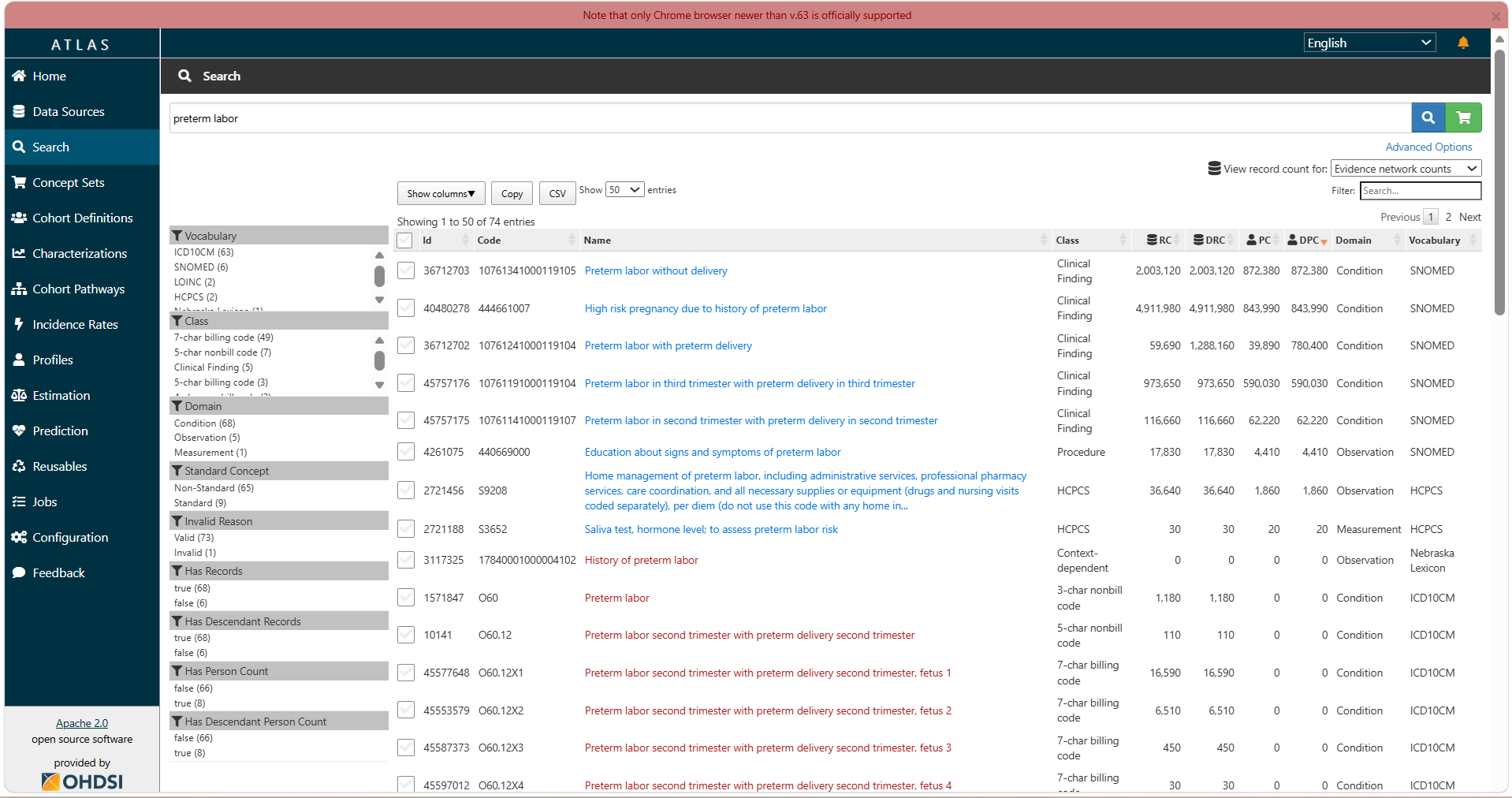
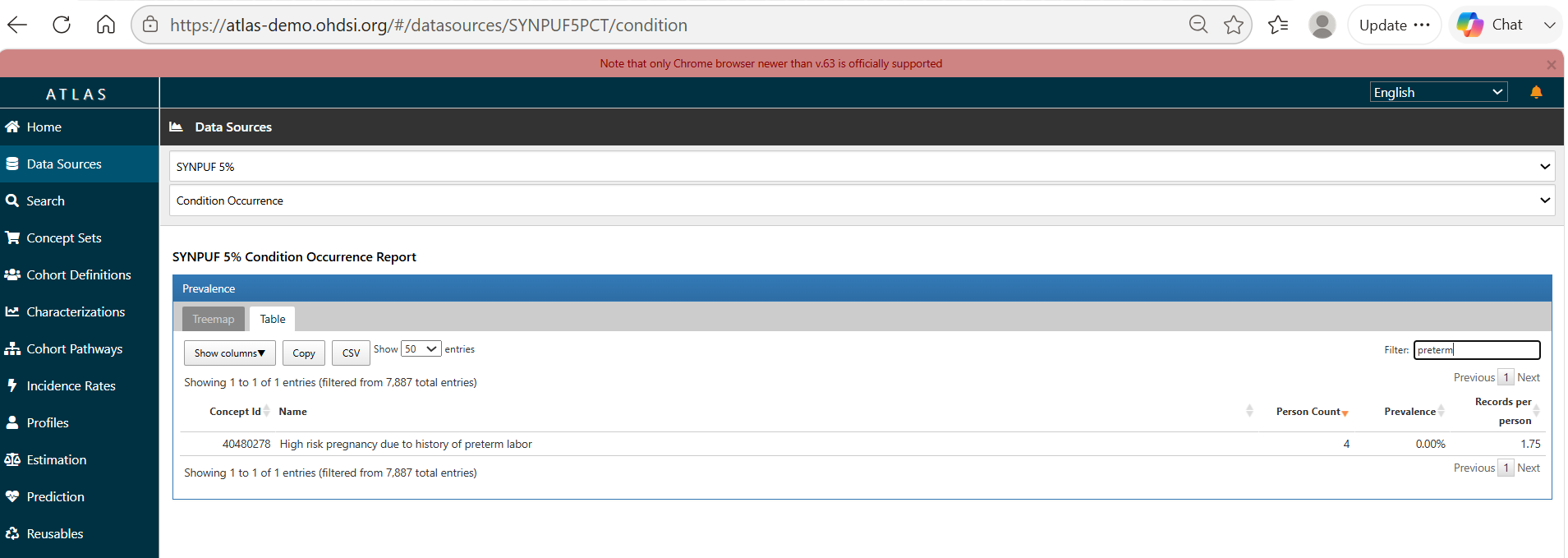
Check the source before the phenotype. A search screen tells you a question is expressible. A data source report tells you whether it is answerable where you work. For preterm labor you want a source that holds obstetric care, such as an EHR with labor and delivery, a Medicaid population, or a birth-linked claims file.
Building a concept set
Two sets, because the two questions people usually mean by "preterm labor" need different code lists. Build both and compare their sizes to see the difference.
Preterm labor, the episode
Labor that began early, whatever the birth turned out to be.
The concepts to include and exclude (6 rows)
| Concept | ID | Domain | Descendants | Mapped |
|---|---|---|---|---|
| Preterm labor without delivery | 36712703 | Condition | Yes | Yes |
| Preterm labor with preterm delivery | 36712702 | Condition | Yes | Yes |
| Preterm spontaneous labor with preterm delivery | 44784550 | Condition | Yes | Yes |
| Preterm spontaneous labor with term delivery | 44784551 | Condition | Yes | Yes |
| Exclude: High risk pregnancy due to history of preterm labor | 40480278 | Condition | Yes | n/a |
| Exclude: Preterm delivery following induction of labor | 37110283 | Observation | Yes | n/a |
Turn mapped on for this one. The ICD-10-CM codes for preterm labor are all source concepts rather than standard ones, and mapped reaches them without listing them by hand. Preterm delivery following induction of labor (37110283) is Observation domain, so it would not appear in a Condition query anyway, and naming it as an exclusion simply records the decision.
Preterm birth, the outcome
A different question, so a different set. Two concepts move between them.
The concepts to include and leave out (6 rows)
| Concept | ID | Domain | Note |
|---|---|---|---|
| Preterm labor with preterm delivery | 36712702 | Condition | In both sets |
| Preterm spontaneous labor with preterm delivery | 44784550 | Condition | In both sets |
| Preterm labor in second trimester with preterm delivery in second trimester | 45757175 | Condition | In both sets |
| Preterm labor in third trimester with preterm delivery in third trimester | 45757176 | Condition | In both sets |
| Not in this set: Preterm labor without delivery | 36712703 | Condition | Preterm labor, no birth on this record |
| Not in this set: Preterm spontaneous labor with term delivery | 44784551 | Condition | Preterm labor, birth at term |
Whichever you build, name it in the protocol as the definition you chose. A set labeled with either phrase will still return a number, so the label is what tells a reader which population you meant.
From concept set to cohort
Build these against a data source that holds obstetric care.
First recorded episode of preterm labor
Every part of the definition (7 rows)
| Part | Setting | Why |
|---|---|---|
| Entry event | Condition occurrence of any concept in the episode set | The domain is unambiguous here, so the risk is which concepts are in the set |
| Initial event limit | Earliest event per person | First recorded episode, not most recent mention |
| Inclusion 1 | Female at index | The concept does not imply sex, so the rule states it |
| Inclusion 2 | Age 10 to 55 at index | Outside that band, expect miscoding rather than obstetric care |
| Inclusion 3 | At least 365 days continuous prior observation | Preterm labor recurs across pregnancies, so a first episode may be a first observed episode |
| Exit | Index plus 180 days, or end of observation, whichever comes first | A pregnancy episode is bounded, so an open-ended exit follows women past the event being studied |
| Censoring | None |
Then check it. Ages should sit roughly between 15 and 45, and the index events should be spread across source codes rather than dominated by one, which would point at a single site's billing habit.
Preterm labor that did not end in preterm birth
Every part of the definition (5 rows)
| Part | Setting | Why |
|---|---|---|
| Entry event | Preterm labor without delivery (36712703) or Preterm spontaneous labor with term delivery (44784551), descendants and mapped on | These are the two branches a preterm birth cohort leaves out, and they are a real clinical group |
| Initial event limit | Earliest event per person | |
| Inclusion 1 | Female, aged 10 to 55, at least 365 days prior observation | As above |
| Inclusion 2 | No concept from the preterm birth set within 30 days after index | Removes women recorded as threatened who then delivered early anyway |
| Exit | Index plus 180 days, or end of observation, whichever comes first |
Comparing the size of this cohort against the first one estimates how much of the preterm labor recorded in your data was not preterm birth. If it comes out very small, suspect that your source records the delivery outcome on the same encounter rather than concluding that threatened preterm labor is rare.
Turning it into a research question
Once you have seen what the vocabulary holds and what your data source records, you are in a position to write a question and judge whether it can be answered. Fill this in, adjust the feasibility answers to match what you found, then download it and load it into the Analytic Use-Case Generator.
Notes and sources
If ATHENA and ATLAS do not quite agree. An ATLAS instance loads only the vocabularies its database needs, and it may be running an older release than ATHENA, so totals can differ between the two. A plain ATHENA search is also deliberately wide, matching synonyms as well as concept names, so it returns far more than a tool showing only the concepts its database uses. Check what your own instance holds, under Configuration, before comparing anything.
Read from an ATHENA search for preterm labor exported 4 August 2026
(download the export), and two screenshots of the
ATLAS public demo taken the same day.
- ATHENA and the ATLAS public demo
- The Book of OHDSI, chapters 5 and 10
- OMOP CDM specification
- OHDSI Forums, Vocabulary Users, if a concept looks wrong and you want to ask
To re-date this page, re-run the ATHENA search and replace the counts, check the concept IDs for deprecation or domain change, retake the screenshots, and update the date at the top.
Corrections or suggestions welcome: danielle@boycedatascience.com